
When you live in Bezons and want to attend the Friday prayer, the instinct is often to check an online calendar to find the time for Dhuhr. The problem is that the time displayed on a calculation site does not necessarily correspond to the actual time of the sermon and the salat al-Jumua at the mosque. Understanding this discrepancy helps avoid arriving too early or, worse, after the sermon has started.
Difference between the calculated time of Dhuhr and the time of Jumua in Bezons
Online calendars display a calculated time for Dhuhr based on the position of the sun over Bezons. In October, this time is around 1:36 PM – 1:41 PM depending on the method used. One might think that it is enough to show up at the mosque at that time.
In practice, the mosque sets the time for the sermon independently of astronomical calculations. Only the local announcement (display at the mosque, official website, messaging group of the place of worship) is authoritative.
To check the prayer times in Bezons before each Friday, it saves time to cross-reference the calculation calendar with the information provided by the mosque you attend.
Methods for calculating prayer times in Bezons: what varies from site to site
Not all calendars provide the same time for Fajr and Isha. The reason lies in the angles used to determine the start of dawn and the end of twilight. Several conventions coexist, each applying different angle values for these two prayers.

Specifically, for the same day in Bezons, the difference in the time of Fajr can reach several minutes between two sites. For Dhuhr, Asr, and Maghrib, the results converge more because these prayers depend on the position of the sun at its zenith or the length of the shadow, parameters that are less sensitive to the chosen angle.
- Fajr and Isha are the two prayers most affected by the choice of calculation method, sometimes with a difference of more than ten minutes.
- Dhuhr, Asr, and Maghrib remain stable from one calendar to another, with differences of just a few minutes at most.
- The method followed by your mosque in Bezons is the criterion to prioritize when choosing the right online calendar.
Before comparing two sites, check the displayed method (often indicated under the schedule table) and compare it with the one practiced at the place of worship you attend.
Time change and prayer times in Bezons in October
In 2026, the switch to winter time is scheduled for the night of October 24 to 25: at 3 AM, it will be 2 AM. This one-hour civil shift alters the display of all prayers on online calendars.
An outdated calendar after the time change displays incorrect times. If you consult a schedule generated before the switch to winter time, each time slot may be advanced by one hour compared to reality. For a Friday falling on October 23 or October 30, caution is advised.
Some useful reflexes around this date:
- Reload the calendar page on the same day to force the time zone update.
- Compare the displayed time of Maghrib with the actual time of sunset (easily verifiable): if the difference exceeds a few minutes, the calendar has not switched.
- Prefer applications that automatically detect the time zone, rather than a static table in image or PDF format.
Particular case of Friday, October 30, 2026
This will be the first Friday after the return to winter time. Dhuhr will change from around 1:40 PM to around 12:40 PM in civil time. The mosque in Bezons will likely communicate a new schedule for Jumua. Check the announcement by Thursday evening to avoid mistakes.
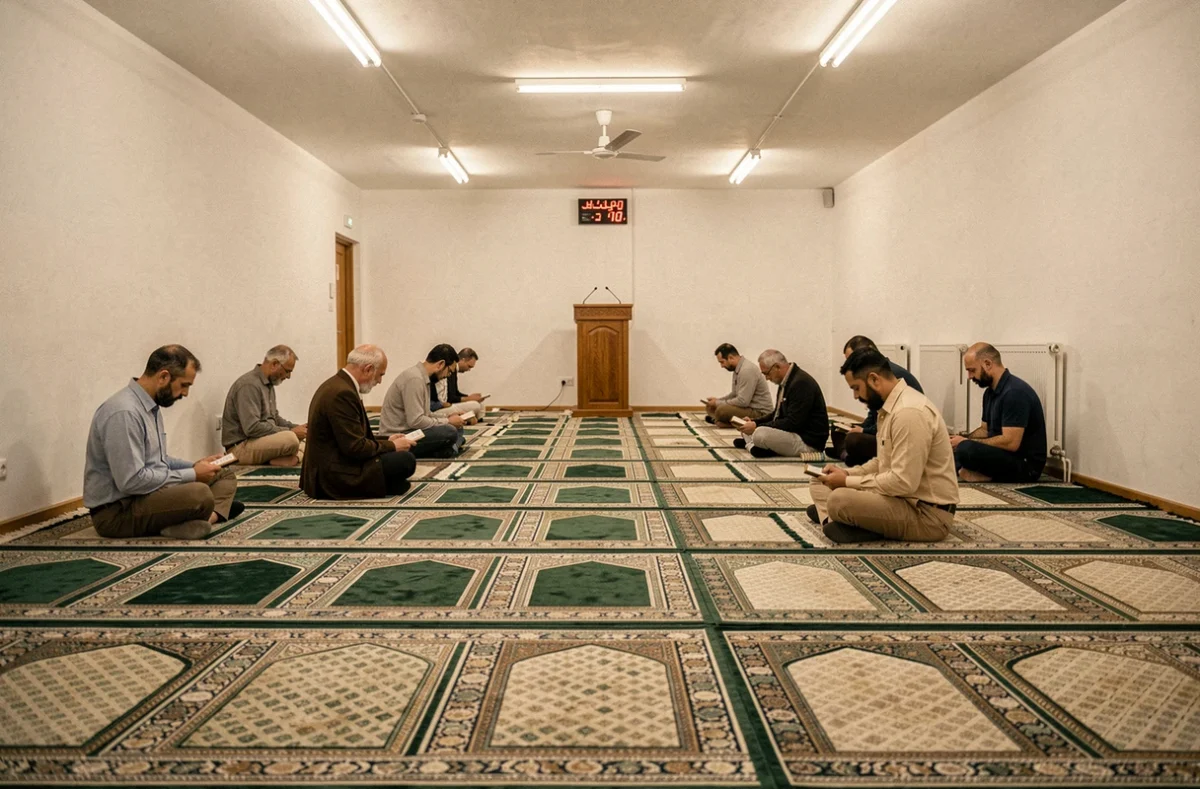
Preparing for salat al-Jumua in Bezons: concrete guidelines
Friday is not just any prayer day. The salat al-Jumua replaces the Dhuhr prayer for those who attend in congregation. Therefore, one does not pray Dhuhr alone at home if one has participated in Jumua.
In Bezons, as in most cities in Île-de-France, mosques generally organize one or two sessions of Jumua when attendance justifies it. Arriving before the start of the khoutba allows you to find a place and listen to the sermon under good conditions.
The choice of calendar to consult depends on the mosque attended. The geographical coordinates of Bezons (latitude close to 48.93, longitude close to 2.22) are used by most sites to calculate the times. The accuracy is sufficient for the five daily prayers, but it does not replace the local announcement for Jumua.
Prayer times in Bezons during Ramadan: Imsak and Iftar
Even though Ramadan does not fall in October 2026, the question arises every year. The time of Imsak (end of the meal before dawn) is a few minutes before Fajr. The time of Iftar (breaking the fast) coincides with Maghrib.
The same methodological discrepancies that affect Fajr also affect Imsak. During Ramadan, a few minutes of difference change the duration of the fast. Checking the convention used then makes perfect sense.
For Maghrib, the calendars converge, and the time of Iftar remains reliable from one site to another. In Bezons, during the summer period, the fast lasts significantly longer than in winter, making the consultation of an updated calendar all the more useful on a daily basis.
The key point to remember: one reliable calendar, aligned with the method of your mosque in Bezons, is better than three contradictory sources. Identify the calculation method followed by your place of worship, set your application or site accordingly, and cross-check with the local announcement every Friday.