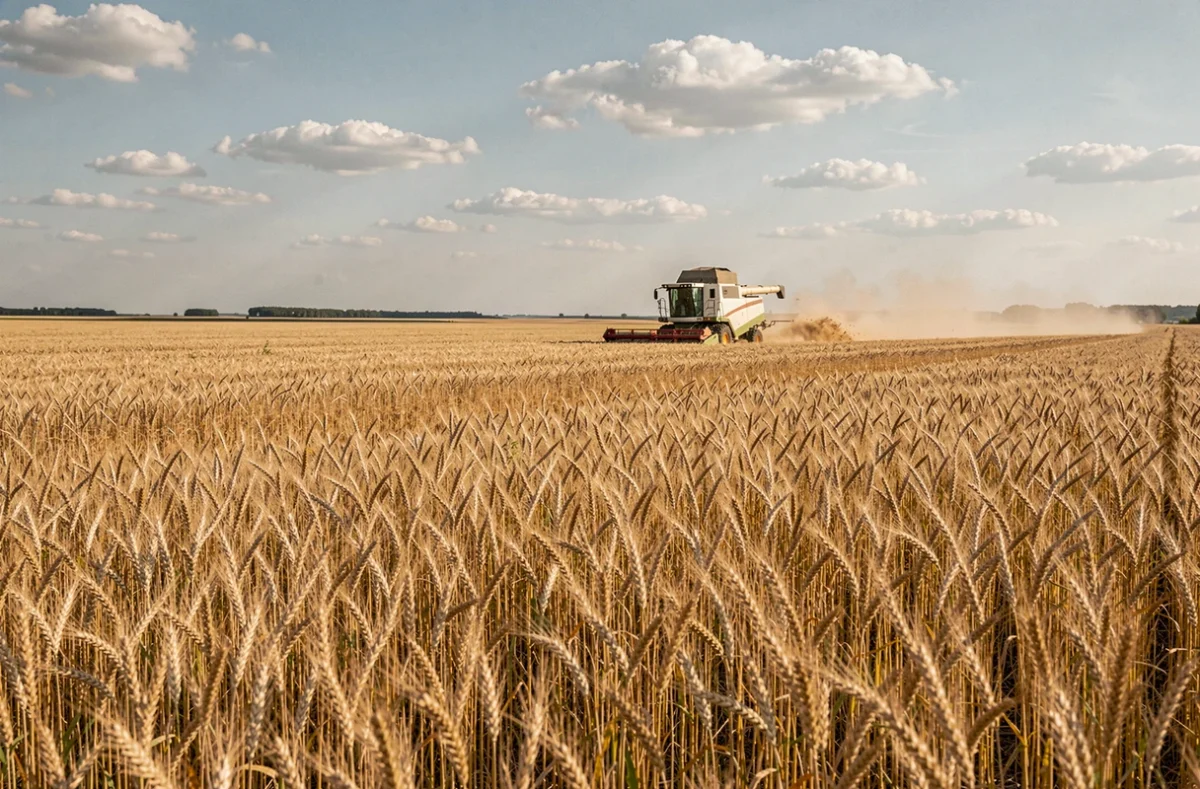
In France, the average size of a farm is around a few dozen hectares. However, some structures far exceed this threshold, reaching several hundred or even several thousand hectares. Identifying who owns the largest farm in the country seems simple, but the answer is much more complicated than it appears.
Why it is so difficult to name the largest agricultural operator in France
You might imagine a single owner, one huge farm, a sign at the entrance with a name. The reality of French agriculture works differently.
The same farmer (or the same family group) can control land through several distinct companies. Legal forms are multiplying: EARL, SCEA, GFA, SCI, economic interest groups. Each holds a part of the land or activity. The real control is hidden behind complex corporate structures.
Let’s take a concrete example. The holding company FLB of François Le Bihan in Brittany oversees at least twenty companies, under different legal forms. When reading an official register, each entity appears separately. Without thorough investigation, no one sees the whole puzzle. When searching for the largest farm in France by hectares, one encounters this deliberate fragmentation of structures.
This is not illegal. The SCEA allows for control of a farm by buying its shares, without going through a traditional land sale. No state service automatically intervenes in these transactions between partners.
SCEA and share buyouts: the mechanism that concentrates agricultural land
To understand land concentration, one must grasp a simple mechanism. Buying an agricultural plot directly is visible: the Safer can exercise a right of preemption, and the structural control checks the coherence of the project. Buying shares in a company that holds that same plot is much more discreet.
Land concentration increasingly occurs through share acquisitions rather than through direct purchases of plots. The Safer group now closely monitors this market. In 2025, this type of transaction involved more than one million hectares, a growing volume.
The Sempastous law, stemming from the Rural Code (articles L.333-1 and following), attempts to regulate this phenomenon. It requires certain agricultural company takeovers to be declared to the Safer. The goal is to make visible what was previously invisible in land statistics.
What this changes for the ranking of farms
When a holding controls ten SCEAs spread across three departments, should all the areas be added together to obtain the actual size of the farm? No official ranking consolidates these areas. INSEE lists farms individually, as does the Agreste register. A group of companies appears as a multitude of small or medium-sized farms, even if a single decision-maker pulls the strings.
Pork industry and large crops: where the largest structures are located
Not all sectors concentrate at the same pace. The pork industry has historically been at the forefront of land accumulation, with integrated farms requiring vast areas for spreading and forage crops.
Large cereal crops (wheat, rapeseed, corn) in the Paris Basin, Beauce, or Picardy also generate very large farms. Some cereal farms exceed two thousand hectares. The PowerBoost video dedicated to a French farm of 2,000 hectares illustrates this reality.
Here are the factors that promote the emergence of very large farms:
- Mechanizable crops on large flat plots, allowing a single operator to manage a considerable area with little labor
- Corporate structures (SCEA, holdings) that facilitate the gradual buyout of retiring neighbors
- More favorable access to credit for already large structures, accelerating the concentration process
The larger a farm grows, the more it can invest in efficient equipment, which reduces the cost per hectare and makes neighboring small farms less competitive. The cycle is self-perpetuating.
Giant farms and succession: a concrete problem
A farm of a few dozen hectares can be passed down to a son or daughter, or sold to a young farmer supported by the young farmer grant. A farm of several thousand hectares, structured as a holding, poses a whole different problem.
The capital required to take over a very large farm often exceeds an individual’s capacity. Only investors outside the agricultural world, or already established groups, can mobilize the funds. This phenomenon is described as the move towards “larger, more capitalized, harder to transfer” farms.
The consequences for the rural fabric
When a single entity manages thousands of hectares, the number of active farmers in an area decreases. Local services (cooperatives, veterinarians, agricultural mechanics) lose clients. Rural schools lose families.
The issue goes beyond the simple record of area. It touches on the organization of territory and the very definition of the farming profession. A manager of an agricultural holding and a farmer on 80 hectares practice two different professions, even if statistics count them in the same category.
Landowner, operator, controlling group: three concepts to distinguish
To answer the question “who owns the largest farm” precisely, three concepts must be clarified:
- The landowner owns the land (sometimes via a GFA or SCI), but does not necessarily cultivate it
- The operator works the land, often as a tenant, without owning it
- The controlling group is the person or holding that decides the direction of the farm, regardless of the legal structure
A farmer can operate thousands of hectares without owning a single square meter. A landowner can hold vast areas rented to several distinct operators. The controlling group can oversee everything through a cascade of companies.
Thus, the answer to the initial question depends on what is being measured. Owned area, cultivated area, or area controlled through companies? Each definition yields a different result, and no public ranking provides a definitive answer. Transparency is improving thanks to the Sempastous law and the enhanced monitoring of Safer, but the veil remains thick over the largest land holdings in France.