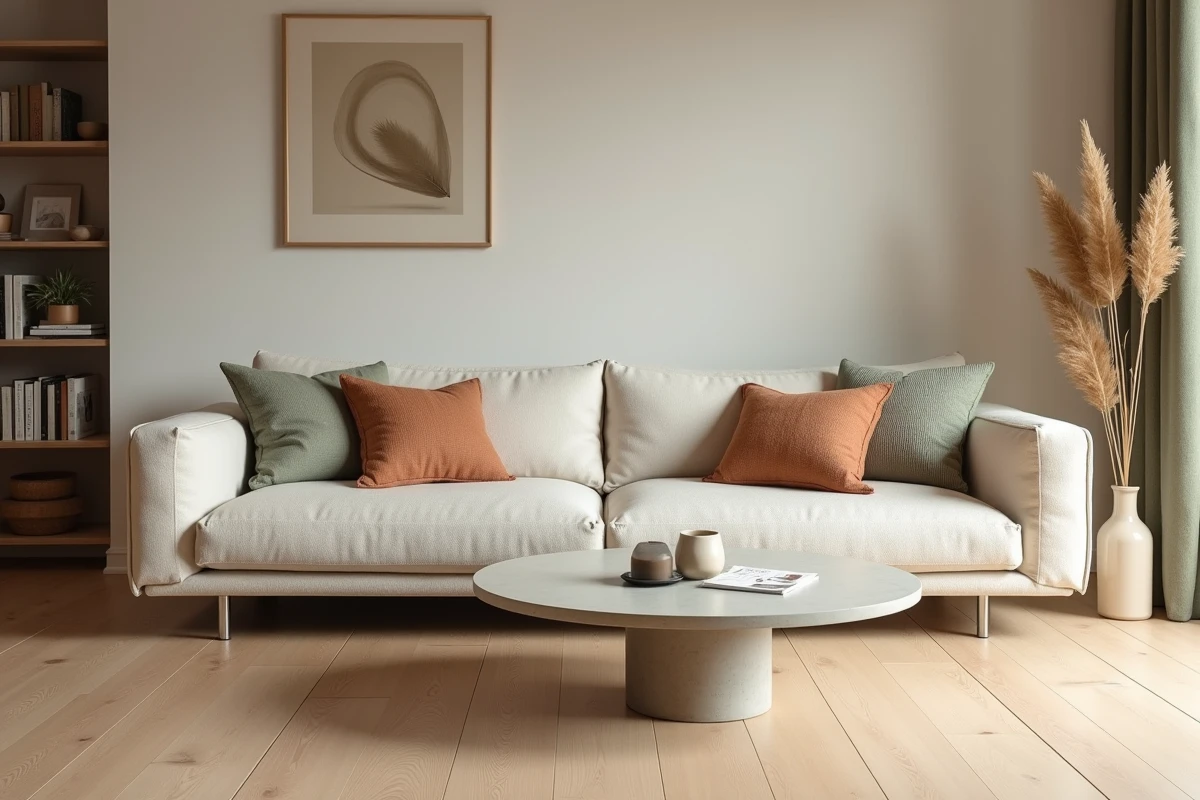
A modern and comfortable home relies less on a decorative style than on precise technical choices: materials, furniture arrangement, light management. These three levers, combined, transform a dated interior into a functional and pleasant living space, without necessarily engaging in heavy renovation work.
Biosourced materials in interior decoration: a technical and aesthetic choice
Biosourced and recycled materials are no longer reserved for construction. The Quality Construction Agency (AQC) notes in its 2024 report that these materials are gaining ground in the realm of interior design: wall coverings, decorative panels, furniture. Their use is becoming a distinctive aesthetic marker of a contemporary interior.
Specifically, this translates into biosourced paints with low VOC emissions, wood fiber panels used as wall coverings, or recycled textiles for household linens and curtains. These materials provide a texture and visual warmth that classic industrial finishes do not replicate.
The choice of these materials imposes a constraint: checking their compatibility with existing supports. A wood fiber panel placed on a damp wall will deteriorate quickly. Many references are now available on directmaison.fr, allowing for comparison of technical characteristics before purchase.
Modular furniture: a concrete response to reducing living spaces
The average size of new homes in high-demand areas is decreasing. The National Agency for Housing Information (ANIL) reports in its 2023-2024 economic note that demand for modular furniture solutions is significantly increasing in surveys of occupants. Modular furniture is no longer a gadget; it is a structural response.
Three categories of modular furniture deserve special attention:
- Convertible sofas with integrated storage, which replace the sofa, trunk, and extra bedding, freeing up several square meters of floor space
- Retractable tables fixed to the wall, which serve as a desk during the day and disappear in the evening to clear the living space
- Mobile partitions on rails, which allow a room to be divided into two zones without masonry work, and revert to an open space in seconds
A common mistake is to choose a modular piece of furniture based solely on its transformation function, without checking its stability in a fixed position. A convertible sofa that you hesitate to unfold because the mechanism creaks does not fulfill its role.
Selection criteria for a durable multifunctional piece of furniture
Prefer gas lift mechanisms over spring ones: they wear out less quickly and do not require excessive force to open. The weight of the closed furniture must remain compatible with your flooring, especially on floating parquet.
A good indicator of durability: the manufacturer communicates the guaranteed number of opening-closing cycles. If this information is absent, the product is probably not designed for daily use.

Natural and artificial light: two complementary systems to calibrate
Light changes the perception of a space more radically than wall color. An identical room appears larger or more confined depending on the intensity, direction, and color temperature of the lighting.
Natural light is primarily managed by what is removed: opaque curtains replaced by sheer drapes, tall furniture moved away from windows, mirrors positioned facing openings to reflect light deeper into the space. These adjustments cost nothing and their effect is immediate.
Color temperature: the often-overlooked parameter
The color temperature of bulbs, expressed in kelvins, determines the ambiance of a room. Warm light (around 2700 K) is suitable for relaxation spaces like the living room or bedroom. Cooler light (4000 K and above) promotes concentration in an office or kitchen workspace.
Mixing two color temperatures in the same room creates a visual discomfort that the brain perceives without being able to identify. Ensure that all light sources in the same space share the same range of kelvins.
- Living room and bedroom: 2700 K, warm light, indirect sources (floor lamps, wall sconces directed towards the ceiling)
- Kitchen and office: 4000 K, neutral light, direct sources above work areas
- Bathroom: between 3000 and 3500 K, a compromise between comfort and color fidelity for the mirror
Colors and wall coverings: laying the groundwork before furnishing
Choosing wall color after purchasing furniture forces permanent aesthetic compromises. The wall covering is decided first, as it constitutes the visual background against which all other elements stand out.
Neutral shades (off-white, light gray, beige) remain the most versatile for living spaces. They allow for a change in decorative style without repainting. An accent wall, meaning a single wall painted in a bolder color, is enough to visually structure the space without confining it to a too-marked palette.
Paint or plaster: a choice that depends on the support
On a smooth plaster wall, paint offers the best balance between ease of application and finish. On an old irregular wall, a lime plaster masks imperfections while allowing the support to breathe. Applying waterproof paint on a wall that needs to breathe traps moisture and causes peeling within months.
The biosourced paints mentioned earlier have the advantage of emitting very few volatile organic compounds, which improves indoor air quality, a comfort parameter often underestimated in decoration projects.
A modern and comfortable interior is built in successive layers: first the walls and light, then the furniture suited to the actual space, and finally the materials and finishes that give the place its texture. Reversing this order exposes one to costly adjustments and a result that does not last over time.