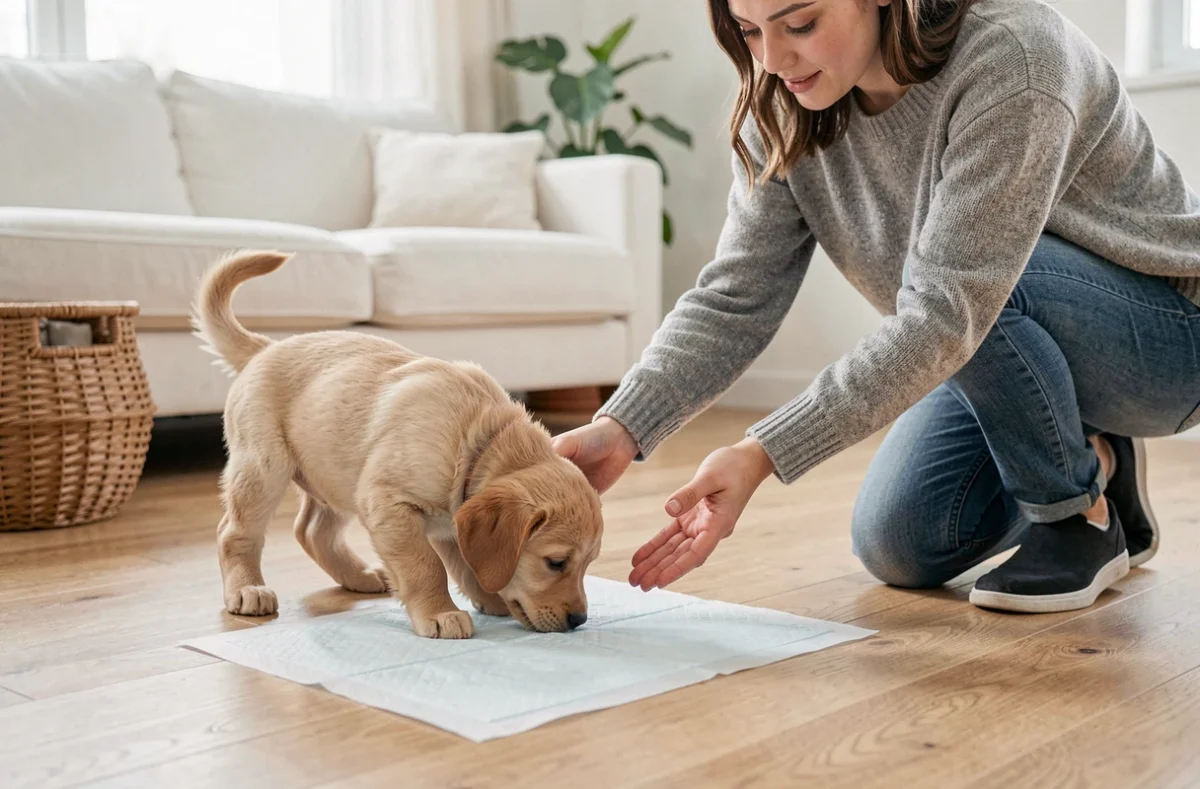
At two months, a puppy urinates on average every thirty to sixty minutes when awake. Its bladder, the last organ to finish developing, simply does not allow it to hold on any longer. Teaching a 2-month-old puppy to be clean primarily involves a precise understanding of these physiological limits, combined with a very high frequency of outings during the first weeks.
Urinary retention capacity at 2 months: what physiology dictates
Recent behavioral guides structure learning around a simple benchmark: age in months + 1 hour as the maximum duration without a bathroom break. For a puppy aged 8 to 10 weeks, this translates to about 1 hour to 1.5 hours of continuous daytime confinement.
In practice, this rule remains very theoretical. The concrete recommendation is to take the puppy out every 30 to 60 minutes when it is awake. At night, plan to wake up every 2 to 3 hours for a quick outing.
Forcing a puppy to exceed these thresholds poses a real risk. Several veterinary sources indicate that holding urine beyond physiological capacities increases the risk of urinary infections and pain. A puppy that suffers while urinating may then associate the act with pain, complicating the learning process instead of accelerating it.
A detailed guide on this issue is available on the British & Co website, with week-by-week benchmarks.
Puppy outing frequency: the factor that truly accelerates learning
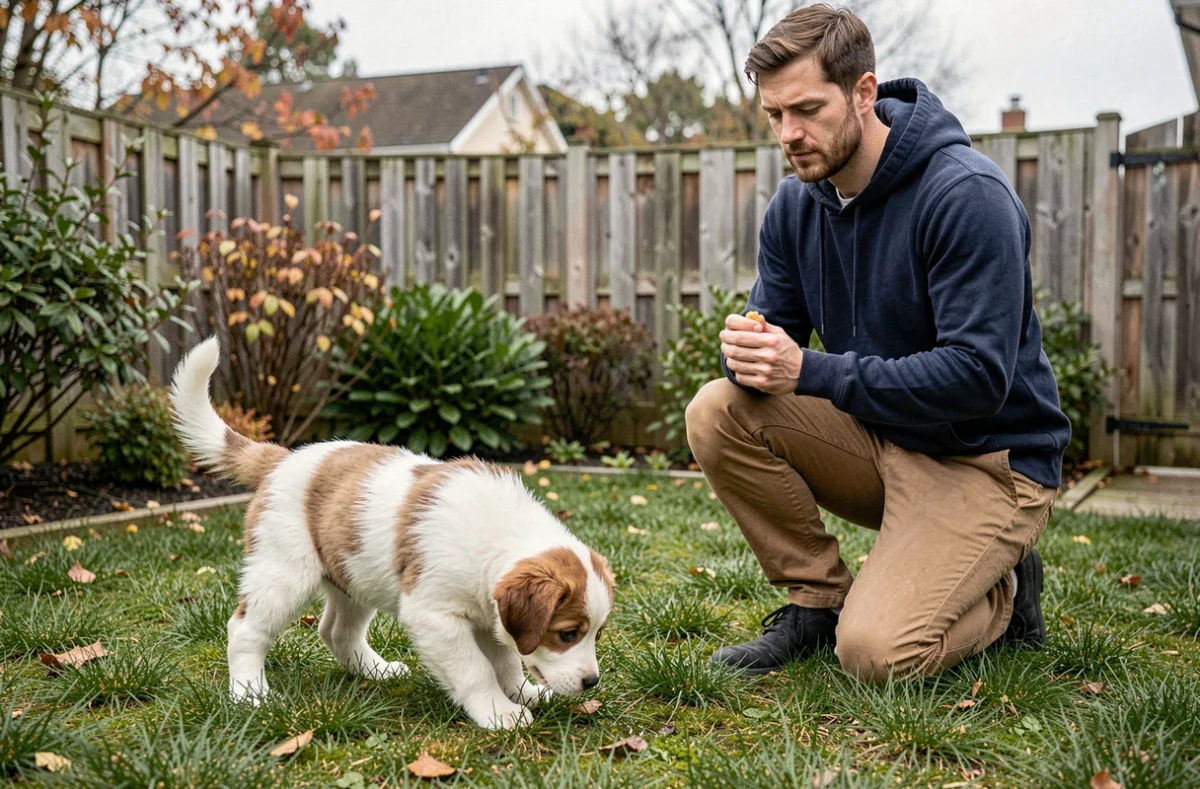
Most online content mentions that you should “take the puppy out often.” This advice remains too vague to be actionable. The difference between learning that takes a few weeks and one that drags on for several months lies in the frequency of outings during the first weeks at home.
Specifically, a 2-month-old puppy should be taken out:
- Immediately after each waking, even after a short twenty-minute nap on the couch
- Within five to ten minutes after each meal, as digestion triggers a gastrocolic reflex that prompts quick elimination
- After each play or excitement session, moments when pressure on the bladder increases
- Systematically just before being caged or put in the park for the night or an absence
Each successful outing (the puppy eliminates outside) should be followed by an immediate reward: treat, cheerful voice, petting. It is the repetition of this sequence that creates the mental association between the outside and the act of eliminating. Waiting until you get home to praise the puppy is too late: it will not make the connection.
Water and puppy cleanliness at night: a misconception to correct
A common reflex is to restrict access to water during the day to limit accidents. Several recent veterinary sources warn against this practice: limiting water during the day increases the risk of dehydration and urinary infections in puppies.
The current recommendation is to keep water freely available all day. The only relevant adjustment concerns the evening: remove the water bowl about 1.5 to 2 hours before bedtime. This reduces the volume of urine produced at night without compromising the puppy’s hydration.
This distinction between nighttime and daytime water management is rarely explained in consumer guides. However, it changes the game for owners who find themselves with a dehydrated puppy in the morning and nighttime accidents nonetheless.
Accidents at home: how the owner’s reaction changes things
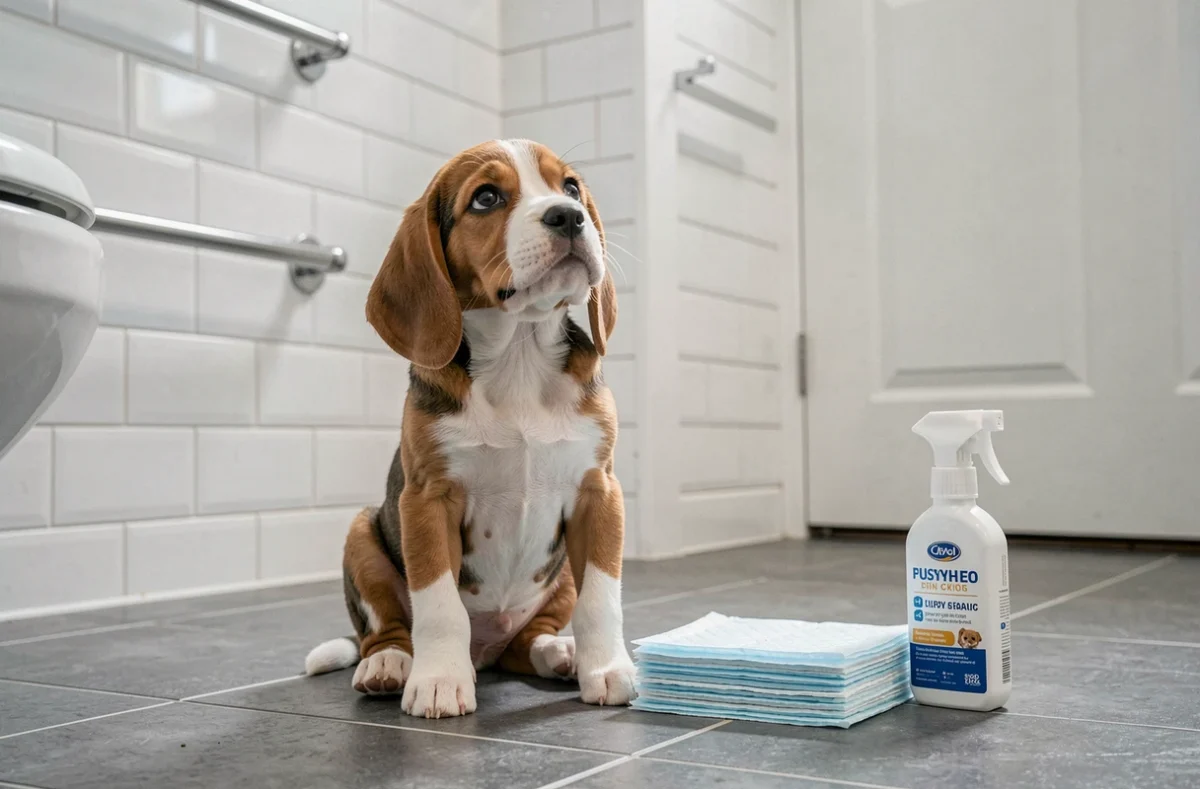
A 2-month-old puppy will have accidents. The question is not how to avoid them entirely, but how to react without sabotaging the ongoing learning process.
Scolding the puppy, rubbing its nose in its mess, or physically punishing it does not produce any positive effect on cleanliness. Available behavioral data is clear on this point: punitive methods create anxiety without speeding up learning. A punished puppy learns to hide to eliminate (behind a piece of furniture, in a distant room), not to hold it in.
The steps to follow in case of an accident are simpler than one might think:
- Clean the area with an enzymatic product, no bleach or ammonia (the smell resembles that of urine and attracts the puppy back to the same spot)
- Do not react in front of the puppy if the accident is discovered afterward: it cannot make the connection between punishment and a past act
- If the puppy is caught in the act, calmly interrupt it and carry it outside immediately to finish outside, then reward it
Training crate and potty pads: useful tools or crutches?
The crate utilizes a natural behavior of dogs: a puppy avoids eliminating where it sleeps. When used correctly, it helps structure nights and short absences. The crate should be just big enough for the puppy to lie down and turn around. If it is too spacious, it may urinate in one corner and sleep in another, which nullifies the effect.
Potty pads pose a different problem. They can create confusion in the puppy between indoors and outdoors as acceptable elimination places. However, for owners living in apartments without quick access to the outside, they sometimes represent the only realistic option in the first weeks. In this case, the pad should be gradually moved closer to the door, then moved outside to guide the transition.
Some dog trainers completely discourage the use of pads, while others consider them an acceptable compromise in urban settings. The goal remains the same in all cases: for the puppy to associate the outside with the place where it eliminates, as early as possible.
Potty training at 2 months is a matter of repetition, not correction. An owner who takes their puppy out about ten times a day during the first two weeks lays the groundwork for cleanliness achieved well before the often-quoted six months. Ten outings a day for fifteen days represent about 150 opportunities to reinforce good behavior, and it is this accumulation that makes the difference.