
A private jet flight begins long before takeoff. Access to the dedicated terminal, customs clearance, and actual time spent waiting on the ground all shape the quality of the journey as much as the leather seats do. When it comes to turning a trip into a luxury experience, seamless logistics matter just as much as the champagne served on board.
Border formalities and a smooth ground experience: what really saves time
A private jet trip to a country outside the Schengen Area involves customs and immigration checks. The difference from a commercial flight is that these formalities take place at a business aviation terminal (FBO), often with a dedicated agent.
A smooth process depends on preparation in advance. A reputable operator submits passenger details to the authorities before the flight, reducing arrival checks to just a few minutes. Without this preparation, you may find yourself waiting on the tarmac, negating the advantages of flying private.
Choosing a branded luxury private jet does not automatically guarantee this level of administrative support. Check whether the broker or operator handles advance declarations, transit visas, and coordination with ground services at the arrival airport.
- Passenger manifests submitted to the destination country’s customs authorities at least 48 hours before the flight
- Verification of visa requirements specific to private flights (some countries apply rules that differ from those for commercial flights)
- Coordination with the arrival FBO for a direct welcome at the aircraft, without passing through a public terminal
A smooth private flight depends on administrative preparation, not the cabin. A passenger who discovers a document issue on landing will have a poor experience, regardless of the aircraft’s level of luxury.

Sustainable fuel and climate impact: what SAF offers actually cover
Since 2025, the ReFuelEU Aviation regulation has required fuel suppliers at covered European airports to provide a minimum share of sustainable aviation fuel (SAF). This fuel is blended with conventional kerosene and can reduce emissions over its entire life cycle.
But it is important to be precise: SAF does not eliminate flight emissions. More importantly, the requirement applies to fuel suppliers, not directly to each operator or passenger. When a broker offers an SAF option, that does not mean the specific flight was fueled with sustainable aviation fuel.
Non-CO2 effects remain a blind spot
The climate debate around private aviation is not limited to carbon dioxide. Contrails and other non-CO2 effects contribute to radiative forcing. The European ReFuelEU regulation provides for monitoring work on these non-CO2 effects, showing that neither SAF nor offsetting programs cover the full footprint of a flight.
For passengers who want a transparent picture of their journey, the question to ask the operator is simple: what exact share of SAF was supplied at the departure airport, and which climate impacts remain uncovered by any offsetting offered?
Cabin and onboard services: the details that transform the in-flight experience
Once the formalities are taken care of and the environmental impact has been addressed, it is time to talk about what happens in the cabin. The onboard experience on a luxury private jet rests on three practical factors.
Cabin configuration tailored to the purpose of the flight comes first. A business trip between Paris and London calls for a different setup than a leisure flight to the Balearic Islands. High-end operators can reconfigure the space: a workspace with a video-conferencing screen, or berths and subdued lighting.
The second factor is catering. We are not talking about reheated meal trays. The best operators work with local caterers and let you order a bespoke menu tailored to allergies, preferences, or the time of the flight. Quality varies depending on the departure airport and how far in advance you place your order.
- Adaptable cabin configuration: work mode (table, connectivity, sound insulation) or relaxation mode (berths, bar service)
- Custom catering ordered from partner caterers, with lead times varying by airport
- In-flight connectivity: check satellite coverage along the planned route, as onboard Wi-Fi remains inconsistent depending on the areas flown over
- Noise and pressurization management: newer aircraft offer a lower cabin altitude, which helps reduce fatigue
What sets an adequate flight apart from a memorable one
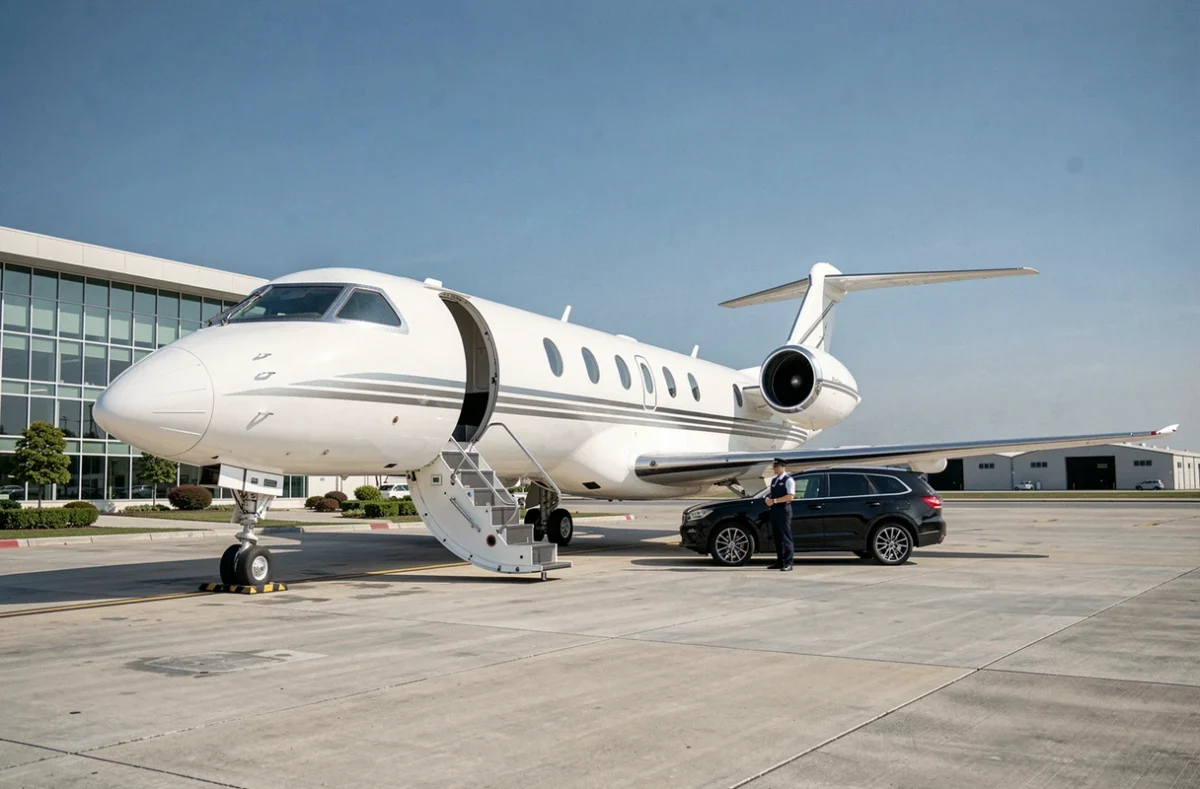
The third factor is the least visible: coordination between the ground and the aircraft. A car waiting beside the aircraft, luggage delivered straight to the vehicle, and a driver briefed on the final destination. These seamless connections turn a simple flight into a smooth journey from start to finish.
This final mile is often underestimated. A private jet landing at a poorly connected secondary airport, with no transfer arranged, loses some of its perceived value. An unforgettable experience does not end at the cabin door.
Pricing transparency and choosing an operator: what to check before booking
The private jet market lacks standardized pricing. The cost of the same route can vary considerably from one broker to another, depending on the aircraft’s positioning, empty-leg return fees, and airport taxes.
Requesting an itemized quote with each charge listed separately helps identify hidden costs. Catering, ground handling, aircraft parking, and any fuel surcharges should all appear as separate line items.
A transparent operator will also provide details about the aircraft on offer, its year of entry into service, and its exact configuration. The promise of a luxury private jet flight rings hollow if the aircraft provided is an aging model with a tired cabin.
The experience of a private jet trip is shaped by practical choices: preparing for formalities, understanding the true carbon footprint, choosing a cabin configuration suited to your needs, and knowing exactly what you are paying for. The finest form of air travel luxury leaves no room for uncertainty between booking and arrival at your destination.