
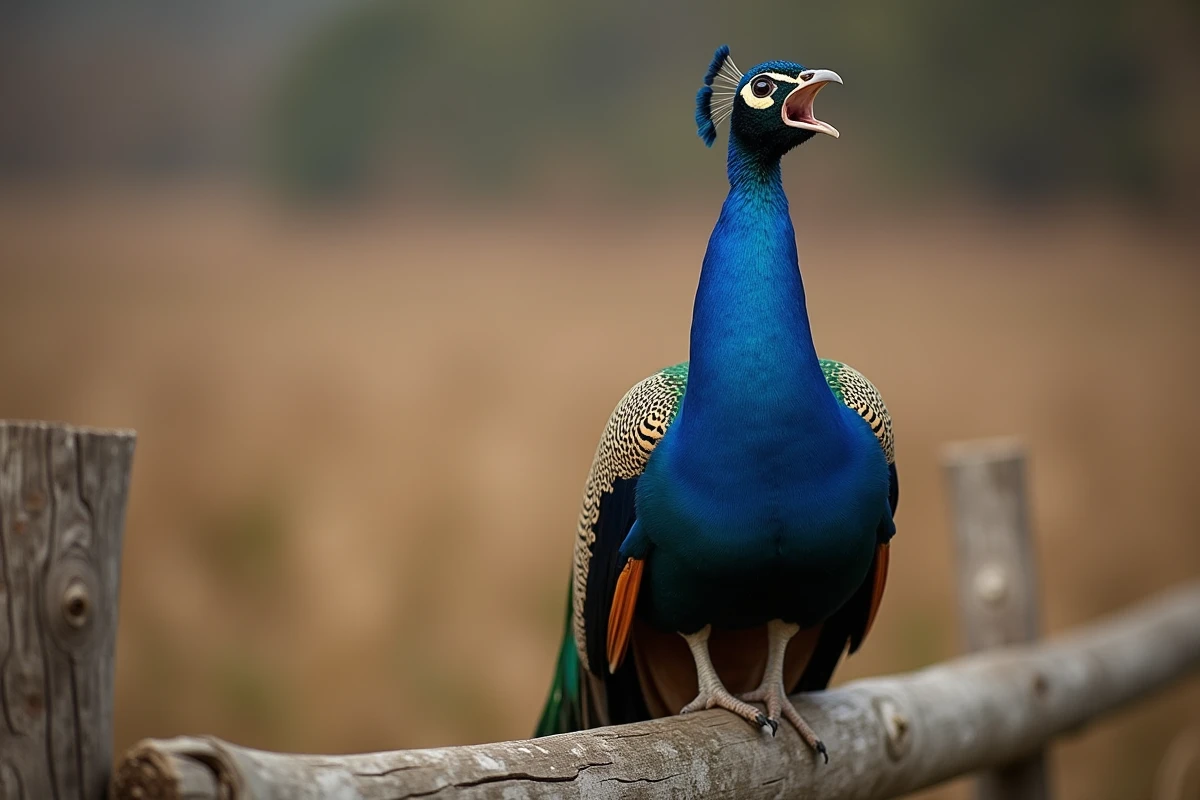
The peacock’s call is unlike any other bird song. This hoarse, powerful sound, often transcribed by the onomatopoeia “léon” in French, surprises as much for its intensity as for the contrast with the animal’s visual elegance. Behind this vocalization lie precise biological mechanisms and cultural influences rarely compared.
Anatomy of the Call: What Produces the “léon” Sound in the Blue Peacock
The blue peacock (Pavo cristatus) has a particularly well-developed syrinx, the vocal organ of birds. Unlike songbirds, whose syrinx produces complex melodies, that of the peacock generates deep, nasal sounds, amplified by the trachea and thoracic air sacs.
The fundamental frequency of the call is in the low frequencies, but the high harmonics give it a piercing quality. It is this combination that allows the call to carry over long distances, far beyond what most terrestrial birds achieve.
The male uses this call in several contexts. During the breeding season, he accompanies his courtship display to signal his presence to females (peahens). Out of season, it serves as a territorial alarm, particularly at dawn and dusk. To understand why the peacock cries léon, one must thus combine vocal anatomy and behavioral context.
Cultural Perception of the Peacock’s Call: “léon” in French, Roar in Hindi
The onomatopoeia “léon” is a Francophone convention. It transcribes a sound that other cultures describe very differently. According to a comparative study from the University of Delhi published in February 2026, titled “Vocalizations and Cultural Perceptions,” the same call is perceived as a tiger’s roar in Hindi (“mayura”).
This divergence reveals how much the perception of an animal sound depends on the linguistic and cultural filter of the listener. The phonological system of a language guides the transcription: French breaks the call into two open syllables (“lé-on”), while other languages hear guttural or nasal sounds.
- In French, the transcription “léon” emphasizes the open vowels and the tonal rise of the call
- In Hindi, the term “mayura” associates the bird with raw sound power, akin to a feline roar
- In some villages in India, the peacock’s call serves as a natural alarm at dawn, long before the rooster’s crow, which conditions a utilitarian perception of the sound
The “léon” does not exist in the peacock’s beak. It exists in the ear of the listener.
Nocturnal Calls in Captivity: What Observations from the Paris Zoological Park Show
Captive peacocks pose a recurring problem of noise disturbances. Their nocturnal calls, triggered by light stimuli or surrounding noises, can disrupt the neighborhoods of parks and gardens.
An internal report from the Paris Zoological Park dated April 2026 documents an interesting approach. After the introduction of mirrors as alternative visual stimuli in the enclosures, a significant decrease in nocturnal calls was observed in captive peacocks. The proposed hypothesis: the mirror’s reflection simulates the presence of a conspecific, reducing the male’s need to signal his position through vocalization.
These longitudinal observations remain preliminary. Field reports vary on this point depending on breeding conditions, group size, and season. An isolated peacock does not react to mirrors in the same way as a male surrounded by females.

Climate Change and the Acoustic Spectrum of the Peacock’s Call
The least documented angle concerns the effect of global warming on blue peacock vocalizations. Several mechanisms could alter the frequency and intensity of the call in the coming decades.
Ambient temperature directly influences the speed of sound propagation in the air. Warmer air transmits sound waves differently, which modifies the range and perception of the call at a distance. For a bird whose reproductive strategy partly relies on vocal range, this parameter is significant.
Shift in Breeding Periods
The blue peacock synchronizes its displays (tail and calls) with the monsoon season in its native habitat, the Indian subcontinent. A shift in the monsoon, documented by climatologists, could delay the period of intense calling. In populations introduced in Europe, where seasonal markers are already disrupted, peacocks are calling over longer periods than they did a few decades ago, according to observations from zoo managers.
Thermal Stress and Vocal Intensity
An animal subjected to increased thermal stress mobilizes more energy for thermoregulation. The available data do not allow us to conclude whether this reduces or increases the male’s vocal investment. Two hypotheses coexist: either the peacock conserves its energy and calls less, or the stress increases alert vocalizations.
What seems certain is that the modification of the surrounding soundscape (urbanization, increased background noise) pushes the peacock to call louder, a phenomenon already observed in other bird species in urban environments. The “léon” could become more strident, not through biological evolution, but through behavioral adaptation to ambient noise.
French Regulation and Protection of the Blue Peacock
The decree of January 15, 2025, published in the Official Journal of the French Republic No. 12 on January 16, 2025, introduced a gradual ban on imports of uncertified blue peacocks. The objective: to protect local populations from genetic hybridization with introduced subspecies.
This measure directly affects breeders and managers of ornamental parks. It imposes genetic traceability for any new animal introduced into the territory. Peacocks already present are not affected, but their breeding will require documented monitoring.
The peacock’s call, whether called “léon” or otherwise, remains an auditory marker of the presence of this bird in the French landscapes. Whether climatic, regulatory, or acoustic conditions evolve, the peacock will adapt its vocalization to its environment, as it has done for millennia. The real question is not so much why it cries “léon,” but what this call teaches us about the behavioral plasticity of a species confronted with a rapidly changing world.